


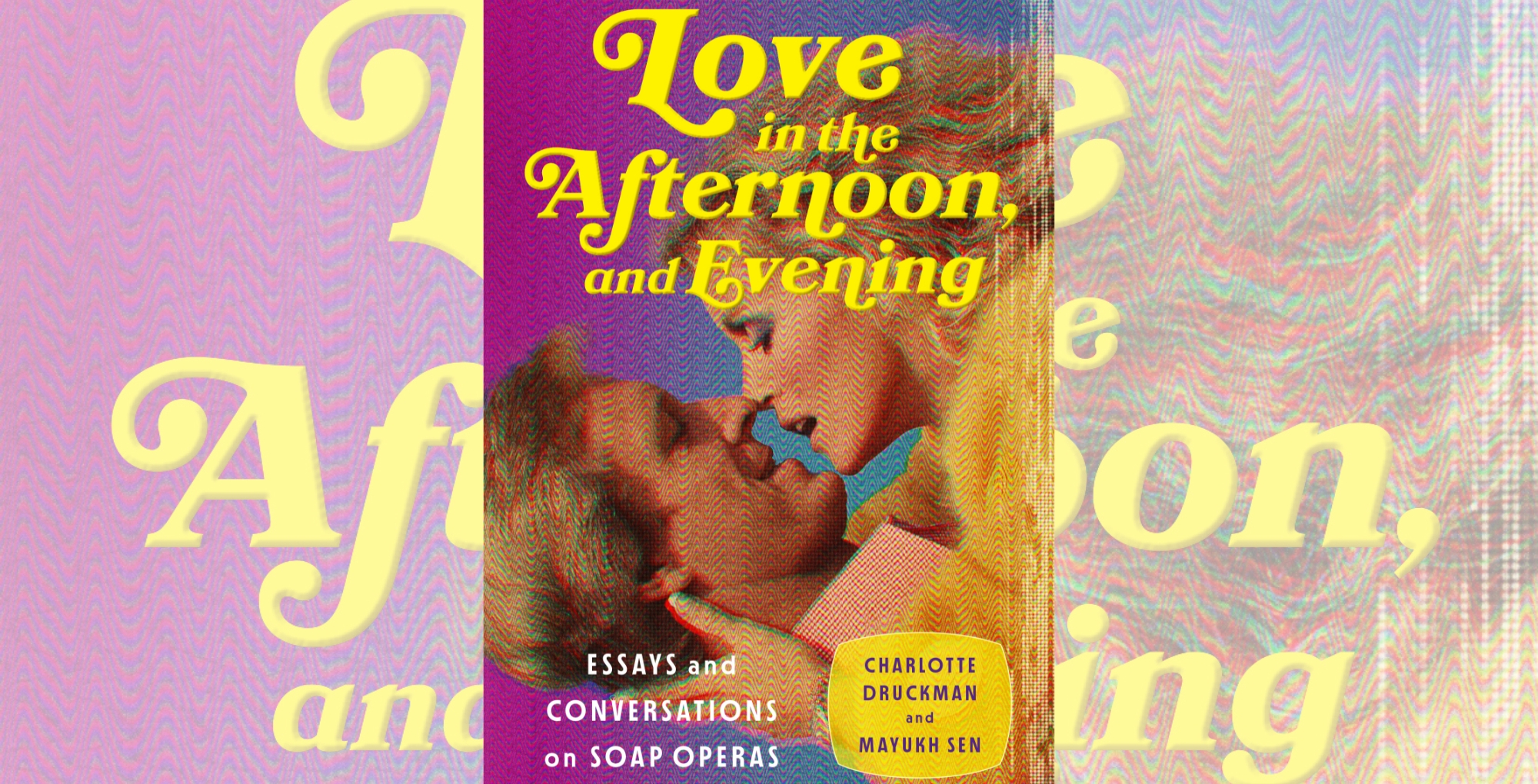
Charlotte Druckman and Mayukh Sen want readers of Love in the Afternoon, and Evening: Essays and Conversations on Soap Operas to know that they’re not scholars. They’re longtime fans of the genre.
Druckman literally cut her teeth watching as a baby in the ’70s, and Sen was a ’90s kid when he was sucked into daytime dramas. But their love for soaps can be as gushing as it is critical. They walk the same line their fellow fans do and have since Irna Phillips created Painted Dreams, changing the world forever.
Druckman and Sen’s book isn’t an exhaustive treatise on the birth of soap operas to the present day. It’s an exploration of the genre, its tropes, triumphs, setbacks, and reimaginings over a near-century of existence.
Their opinions, critiques, and love letters to their favorite series examine why viewers stick with soaps even through frustrating storylines. As well as why we return daily to see what happens next, be it compelling or ridiculous.
Their generational gap offers a view of the genre from the perspectives of two people who came of age at different points in its history. Druckman experienced the golden age of daytime and primetime soap operas. In contrast, Sen watched as they began to sunset and budgets were cut.
While Love in the Afternoon, and Evening isn’t a comprehensive history of soaps, it covers quite a bit of ground from the taboo to the splendor found on series that used to be titans of the industry.
Below is an excerpt from the beginning of the book. Dubbed a “promo,” it launches right into Druckman and Sen’s backgrounds as they interview one another about what pulled them down the rabbit hole into soap operas. Love in the Afternoon, and Evening hits shelves Tuesday, May 12.

Love in the Afternoon and Evening Excerpt
Promo
“Opening Dialogue”
CAST
Millennial Writer: Mayukh Sen
Gen-X Creative: Charlotte Druckman
Charlotte: I want to know how and when you fell in love with soaps, and what it was like to be a regular viewer during that time. Because you started a good twenty years after I did. I started watching the daytime shows at four months old, thanks to my caregiver, Totes1. It was 1975, a few years before they entered what’s considered the pinnacle of the golden age of soaps, which was basically the ’80s. They would start at noon, across the three major television networks, and go to at least four in the afternoon.
Mayukh: I should preface what I’m going to say with this: We were an ABC family. When I was a child in the late ’90s, there were already fewer daytime soaps than you were used to. There was a block of daytime programming on that network that started at 1:00 p.m. with All My Children, which was followed by One Life to Live at 2:00 p.m. and General Hospital at 3:00 p.m. That would lead into Oprah at 4:00 p.m. Before any reader tries to interject, I know that Port Charles was also on somewhere in there in some markets, but it wasn’t airing regularly in my little corner of New Jersey. Loving and its offshoot The City weren’t on my radar at all.
I saw soap-watching as a nice, regular diversion, even as a child, along with entry into an adult world I didn’t otherwise have access to. This was back when soaps were a little racier. I still remember the sight of Nik and Courtney on General Hospital steamily hooking up one summer, like something you’d see on The Spice Channel. It was also an excuse for me to gather with certain family members, specifically my paternal grandfather, who was an immigrant from West Bengal and who started watching these soap operas in the early 1980s when he first came to America. I got absorbed in the narratives that I was seeing before me every single day.
Charlotte: What was it about them that hooked you?
Mayukh: It’s hard to say what I found compelling at that time. When you watch these shows through the eyes of a child, it’s easy to miss the finer nuances of the art—like performances, for example—because you don’t totally have the ability, or vocabulary, to understand or articulate why, say, a certain character and their machinations are striking such a chord with you.
When I became really obsessed with soaps, it was 2005; I was thirteen years old. This was before YouTube had a wide library of soap clips you could mine, although the cable channel Soapnet, which is now defunct, was certainly around and doing a lot to keep those old shows circulating.
The way that I would engage with the so-called soap fandom at thirteen was by lurking around certain message boards. There, I would see people talk about storylines and scenes from yesteryear without my being able to watch them. That’s how I learned Judith Light had once been on One Life to Live, for example.
Charlotte: Those message boards didn’t exist when I was a kid. There were just things like Soap Opera Digest. Sometimes, when I was home sick, my dad would ask me if I wanted any Archie comic books, and I remember at some point sheepishly asking for Soap Digest instead. It was awkward. Did you continue watching soaps straight through high school and into college?
Mayukh: Shortly after my brush with “the fandom” was when I fell out of the habit of watching soap operas every single day. By the time I got to high school, my grandfather had died, and a number of other life circumstances just made soap-watching less of a priority.
Charlotte: I think I’d stopped watching a few years before that, in the early aughts, after grad school. But I’d check in from time to time. ABC still had a pretty robust daytime lineup—All My Children ended in 2011, and then One Life to Live the following year. General Hospital is the only one still standing. So then after college, you developed a newfound interest in them, right? What happened?
Mayukh: Fast-forward to 2021, when we’re still in the shadow of the pandemic, and I have this kick of nostalgia that makes me start revisiting soap operas. I queue up General Hospital on Hulu, where that day’s episode gets posted at 8 p.m. And I start just getting reabsorbed in the storylines, picking up where I left off. The beauty of soaps is the fact that so much change can happen over time, but because of the nature—and pressures—of the daily storytelling, certain narrative beats can repeat. That allows a viewer like myself, who hasn’t necessarily been following the show day-to-day, to come back in and immediately get caught up. There are certain faces or names you can latch onto as points of familiarity, like old friends.
Charlotte: Yeah, it’s true. Except, something about seeing them now, when they’re older, but trying to fight the aging process, and still acting the same makes me a little depressed. But you also got really interested in the history of soaps and started going back to watch clips of past performances on YouTube, which is a totally different way to consume them. What’s it like to experience soaps, having gone from seeing them every day, as a repetitive entity, to seeking out isolated episodes or clips?
Mayukh: I started to seek out older clips from the shows on YouTube—including ones I had a vague memory of from my youth. I started to ask myself, What was it about these storylines and these characters that bewitched me so much when I was a kid? And through that, I was able to reacquaint myself with, and really study, the work of all these actors who had made such a deep impression on me, even if I had maybe forgotten their names or the specifics of their story arcs. I then started to brush up on my history and familiarize myself with an era of daytime soap storytelling that predated my very existence on this planet. Shows like Ryan’s Hope that had ended before I was born were now available on YouTube, and sometimes I’d put them on in the background and see this entire generation of soap actors and characters—Delia and Maeve Ryan!—I’d never really known before.
Charlotte: I love it. I watched Ryan’s Hope as such a tiny person, but I still remember Maeve with her black chin-length bob and Irish accent, and I adored Delia. She was a pistol and a mess. I’m glad she lives on, though. I want to go back to the streaming because I assume it makes no difference what time you’re watching General Hospital, or does it? And are you binge-watching episodes back-to-back?
Mayukh: Yes, and I’ve realized that there are some downsides to streaming soaps if you binge-watch them, as people my age are wont to do. Soap operas are not always conducive to that sort of experience. You see the cracks in the execution more easily. There have been times where I’ve tried to catch up on General Hospital episodes that I’ve missed, and so I might watch three or four a night. But midway through that process, I’m exhausted. It feels as though all these stories are blending into one another, and I’m really not getting pleasure out of the experience. I don’t think that’s as likely to happen if you watch a soap opera at a set time, once, every single day; as long as the showrunners are doing their job well, you’re waiting with bated breath for the next episode, which you know will come on at the same time the next day. There’s consistency, and there’s anticipation. The streaming model, or at least the sort of viewing habits it can breed, almost runs counter to the way daytime soaps are constructed as an art.
Charlotte: With the daily shows, it’s about that drawn-out progression of time; the denouement is always really fast, but the buildup to it is equally slow. That’s why I always thought Friday was the best day for soap operas; each show ended with some kind of cliffhanger to ensure that you came back and watched on Monday. I’ve come to believe that the best way to watch a daytime soap is to tune in on Mondays and Fridays and skip the rest.
You couldn’t do this with prime-time soaps, which I also started watching as a child. That’s where my heart lies. I’m so glad you brought up Soapnet. I think I was in my late twenties when I discovered that on Saturday nights between 1:00 a.m. and 6:00 a.m., that network would air five back-to-back episodes of Dynasty, with ads, of course.
When I was a kid, my parents were home on Wednesday nights when Dynasty aired, and they wouldn’t let me watch it. I could hear the theme song blaring from their TV down the hall and think it was so unfair. I thought surely it must be so racy and amazing if I was banned from watching it. So, when I found it on Soapnet, it was like I’d hit pay dirt. I would be out on a Saturday night, at a bar with friends or at a party at someone’s house, and there would be this moment where I would check in with myself and I’d be like, How much of a good time are you having? Are you having a good enough time that you want to stay here? Or would you rather be home watching Dynasty? And I’m not kidding, most of the time the answer was, I want to go home and watch Dynasty, and I would; I would stay up till 6 a.m.
It worked only because it had initially aired weekly, so there wasn’t a lot of repetition. I couldn’t really get bored. And time was forced to jump sometimes, because there were seasons, and they went on hiatus, and it was such a relatively limited number of weekly episodes per season.
Mayukh: You’re reminding me about one of the virtues of watching old soap clips on YouTube. If you know the outcome of certain storylines—and you’re aware of what kind of payoff they will have—you can focus on other elements in a way that might be kind of challenging for you to do in real time because you’re anxious for the plot to progress. One example that comes to mind involves our beloved Carly—let’s just call her Carly, to spare you her many married surnames. When she first traipses onto the General Hospital scene in 1996, only the viewer and a few other people in town know that she is the long-lost daughter of nurse Bobbie Spencer—or Bobbie Jones, as she was called back then. But that’s a secret she keeps from Bobbie for two whole years, until an explosive reveal during February sweeps in 1998. Imagine waiting that long if you were watching it back then!
Charlotte: And that’s like an eon in soap time for that type of secret. Some secrets lie buried, but usually the whole “I am your daughter” or “I am your father” reveal wouldn’t take a full two years.
Mayukh: And I can’t imagine how frustrating it might have been for some viewers, even if I’d argue that it was ultimately worth the wait, because that entire arc was handled so beautifully by the writers. But I’m reminded, too, of the same frustrations that viewers might have when watching certain prime-time shows. The same thing happened when I was watching The Sopranos for the first time—I know that the first half of season six still gets criticism from fans who feel it starts off strong and then peters out. Now, though, it’s obvious that so much of what that season puts in place is just a prelude to the brilliance of the second half of the final season, when everything crescendos. But it must have been very difficult for viewers back in the aughts to wait an entire year for that next season.
Charlotte: If you’re a total nerd and you want to then go back and watch the first episode and the last episode back-to-back, it’s nice to be able to see those things that the architect of The Sopranos, David Chase, was already seeing, but that we couldn’t when we were watching it in real time.
If you ask me, the worst—the real, true throwaway season of all time—was Dallas, season nine. At the end of the previous season, Bobby Ewing gets killed off. I don’t know why they wrote him off, maybe he wanted “to pursue other opportunities,” as they say, but they do this whole season without him where everyone moves on. Poor Sue Ellen, who’s a recovering alcoholic, has a serious relapse. Pam, Bobby’s ex-wife and one true love, resumes her relationship with annoying Mark Graison, whose own death gets rewritten as fake. Ratings dropped. I guess viewers were just like, “This is unbearable without Bobby.” Larry Hagman, who played uber-villain J. R. Ewing, approached the execs to bring him back. And lo and behold, in the final scene of that season, Pam wakes up, walks into the bathroom, and pulls back the shower curtain, finding Bobby alive and well, and the whole season is written off as a bad dream. I’m not sure if viewers were more up in arms about his demise or this just kidding maneuver. There was no way to smooth it over. I think everyone was just so happy to have Bobby back that we, as viewers, accepted it. We complained, but we kept on watching.
Mayukh: You decide to forget that this ever happened.
Charlotte: We agree to let it go. Generally, soap fans are extremely vocal and opinionated, but we’re also extremely forgiving. And there’s been a lot to forgive over the years, hasn’t there?
To be continued.
Excerpted from Love in the Afternoon, and Evening: Essays and Conversations on Soap Operas. Copyright © 2026 by Charlotte Druckman and Mayukh Sen. Used with permission of the publisher, W. W. Norton & Company, Inc. All rights reserved.
