


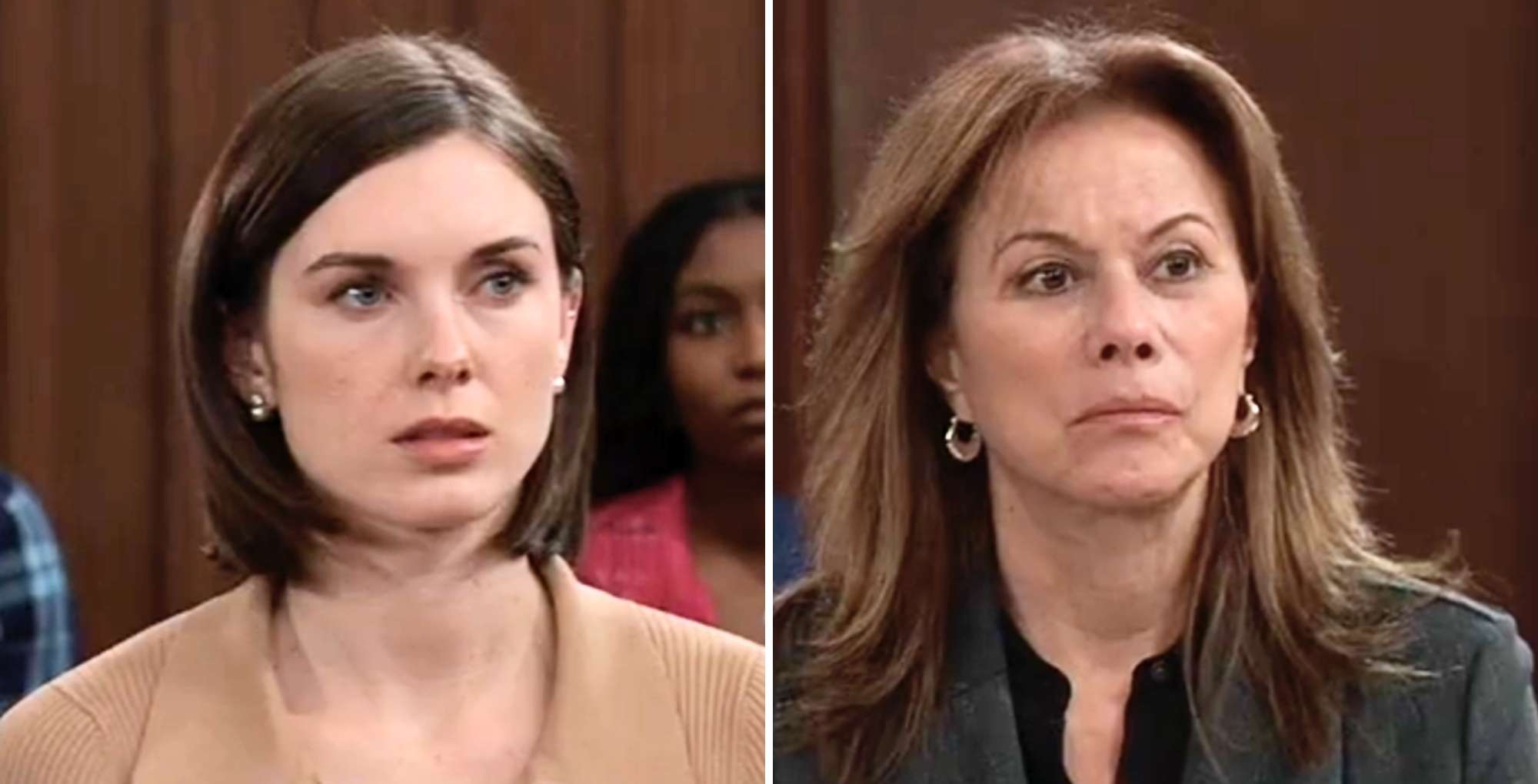
General Hospital‘s Alexis was horrified to realize that her client, Willow, was, in fact, guilty of shooting Drew. We’re not sure why. Everyone in Port Charles is a criminal, including Alexis, all of her relatives, her baby daddies, and her children. She asked Diane how she could possibly defend someone who’d actually done what they were accused of! Luckily, Diane reminded Alexis of what a defense attorney’s job is. But, to us, Alexis’ dilemma felt very familiar. Though she didn’t quite go in the same direction as the last ABC legal eagle.
Key Takeaways
- Alexis went ahead and defended Willow in her closing arguments.
- One Life to Live’s Nora Gannon once faced the same challenge.
- Headwriter Michael Malone recalls the Emmy-winning story.
Staying the Course
Up until the moment when she gave her closing argument to the jury, we were afraid Alexis (Nancy Lee Grahn) would go in the same direction as Nora (Hilary B. Smith) on One Life to Live who, upon coming to the conclusion that Todd (Roger Howarth) and his cronies, whom she was defending on charges of gang rape, did indeed commit the crime, gave a summation which incriminated her clients. Nora should have lost her law license for that.
But Smith won a Daytime Emmy for Outstanding Lead Actress. In the book, Super Soap Scenes: A Time Capsule of Daytime Drama’s Greatest Moments, the late OLTL headwriter Michael Malone recalled his first breakout hit story:
Michael Malone
It was one of the first stories I’d told on One Life to Live. In it, Marty (Susan Haskell) was a spoiled, rich, needy, and recklessly self-destructive young woman, with a veneer of cynicism over a troubled core.
When Andrew Carpenter (Wortham Krimmer), the young minister, rejected Marty’s sexual advances, she retaliated by spreading the lie that he was sleeping with a teenaged boy named Billy Douglas (Ryan Philippe in his first role). Marty’s lies almost destroyed the minister, divided his church, and troubled the town. (Co-writer) Josh Griffith and I named the story “The Accusation.”
“The Accusation” led to the next story: one of the most challenging and controversial we did during my tenure on the show. Remembering the story, people call it “Marty’s Rape” or “Marty and Todd.” It was a graphic, honest, intensely emotional, extensively researched portrayal of the too-often unreported crime of college rape, in this case, a gang rape by three fraternity men. The victim was Marty, a fellow student who already knew them, who had previously had sex with one of them, and who was intoxicated at the time of the rape. The “message” of the story was that none of these circumstances mitigate against the fact that rape is rape and rape is a major crime. The story has had a strong effect both on its creators and on its audience.
Winner Takes It All
The rape was instigated by Todd Manning, a character who had first arrived in story notes as “Frat Boy #1.” Just like Marty, Todd was spoiled, rich, needy, and recklessly self-destructive, with a veneer of cynicism over a troubled core. Like her, Todd was a liar. But Marty was known to have lied about Andrew Carpenter and Billy Douglas. So when she cried rape, no one believed her, including Nora Gannon, the attorney who was defending the accused rapists because she believed them to be innocent.
Susan Haskell, Roger Howarth, and Hillary Smith went on to win Emmys for their searing performances in this story. The writers were honored with an Emmy. But our Emmy belongs to the whole company. The community of serial drama is another pleasure of the genre to me. It takes a village of artists to create a soap opera. It’s a daily collaboration among actors, designers, technicians, directors like Jill Mitwell, who so powerfully envisioned the rape episode, producers like Linda Gottlieb, who fought so hard for the integrity of the story. It is also a collaboration with the audience. Soap opera viewers care passionately about story and they don’t hesitate to let you know what they think. (Neither did the readers of Dickens’ novels, also serialized.)
For more from Malone as well as dozens of other soap opera insiders, check out Super Soap Scenes: A Time Capsule of Daytime Drama’s Greatest Moments.


